Showing posts with label Music Language. Show all posts

Thursday, January 29, 2015

Ties and Slurs

Ties and slurs are kind of articulations in music. Although a tie is not actually an articulation but still we are okay to call it so because of its similarity with the slur on the music sheet. Let me describe each of them separately so that you can understand what are they and the difference between them.

THE TIE

A tie is a curved line connecting two or more notes of the same pitch. Just like tying one piece of string to another gives you a longer piece of string, so tying two notes together makes a longer note. There is no break between tied notes. Ties are often used to join notes over the bar line.
Below is an example of how a tie looks on the staff.


THE SLUR

A slur is a curved line connecting two or more notes of different pitches. Notes of different pitches with the curvy line over or under them are articulated as smoothly as possible. For guitar players it means hammer- ons and pull offs. Means whenever you see those curved lines over the notes, you should note pick them up as it will give the notes a discrete feeling. The slur means you need to play it in such a way that the notes flow by as much smoothly as possible. Hammer ons and pull offs are the best ways to perform the desired action.
Below is an example showing slur.


I hope now you very well know the difference and similarity between ties and slurs. 

Saturday, August 2, 2014

Beats, measures and time signatures

Just like we use a clock to measure the speed of a process or to divide our time into hours, minutes and seconds, we similarly have devices or methods, whatever you would like to say, to measure music.To measure music with respect to time we have some terms that need to be defined first.

BEAT: This is a regular pulse that can be heard or implied or felt. Just like heartbeat.

TEMPO: This is the speed of the pulse.

MEASURE/BAR: The space between two bar lines.


METER: This is the time signature. It tells how many beats are there in each measure.

RHYTHM: All of the above things combined together give the rhythm of the music. So you can vary the rhythm just by varying any of the above.

Now how to read time signatures or meters? You must have come across things like 4/4 or 3/4 or 6/8 etc.  Let us first define note values/duration.


Now how much time is equivalent to one beat? If the time signature is 4/4, then the quarter note ( the denominator) gets one beat equivalent time. If it is 3/8, then one beat will be measured by an eighth note and so on.

Time signature tells you how the music is to be counted. The time signature is written at the beginning of the staff after the clef and key signature.


Time signatures consist of two numbers written like a fraction. The top number tells you how many beats to count and the bottom number will tell you what kind of note to count ( quarter notes , eighth notes etc).

Let us take the example of the common time signature 4/4. This means count 4 (the top number) quarter notes (the bottom number) to each bar or measure. So the rhythm feel or the pulse count is like 1-2-3-4, 1-2-3-4, 1-2-3-4 and so on. Now the time signature 4/4 implies that all the notes in a bar must add up to 4 quarter notes. You can use sixteenth notes, eighth notes whatever you want, but the total sum should be 4 quarter notes. For example you can use 8 eighth notes or 4 eighth notes and 2 quarter notes etc. Because in each case you will be taking time equal to 4 quarter notes.

There is special symbol for some common time signatures. The 4/4 is called the common time and a C (this is not actually a C, it is a half circle) is written in place of 4/4. Another is the 2/2 which is also called cut time. It is represented by a C with a slash through it.


Friday, August 1, 2014

How to read music- Basics


 As any other language, there is syntax for writing music on paper. Music is written on a grid of five horizontal lines called the staff. The staff looks like the one given below.


The notes are placed on this staff and they represent relative highness or lowness of pitches.


Each of the lines represents a note name. The note names are always arranged in an alphabetical order as given: A B C D E F G (This is in a cyclic manner of course). The positions of the notes are decided by the clef that is present at the beginning of the staff. There are three types of clef. The ‘F’ clef, the ‘G’ clef and the ‘C’ clef. The F clef is also known as the bass clef and it fixes the position of the F note on the staff. After that we can follow the order of notes to know the position of other notes. Similarly the G clef also known as the treble clef fixes the position of G note on the staff and the C clef fixes the position of C note on the staff. The following images will clarify everything.

The F clef
The G clef
G and the F clef shown together
The C clef
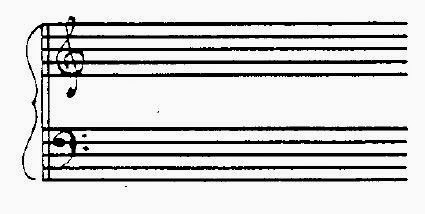
When the bass clef and the treble clef are combined together we get the staff known as the grand staff or the great staff. Below is an example image of a grand staff.

                                                                       
The grand staff

Now what if we want to write notes which have higher or lower pitches than the staff can contain? In that case we draw extra small horizontal lines above or below the staff lines as the requirement may be. Below is an example image for the same. These extra lines are called leger lines.


Notice that if you want to add a note which is directly above a staff line or leger line, you do not require additional line to place that note.


Now you may be thinking that there are twelve notes in total and the staff shows only the natural notes. What about the accidental notes? How to place them on the staff? Well there is a very simple way to do this. A sharp (#) or a flat (b) is added just before the note to make it sharp or flat respectively. But when we write‘#’ or a ‘b’ on any staff line, it continues to affect all the notes ahead placed on that line. So what if we want a C note after a C#? We must know how to cancel the effect of this sharp. For this we have a special symbol which is called natural. The following image will clear everything.


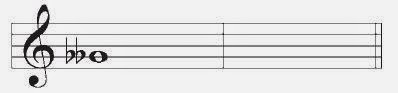
When we need to make a note raise or lower by two half steps, we need to add a double flat or double sharp.
A double flatted note


 One more thing that you must notice is that we have five different kind of accidentals. They are double flat, flat, natural, sharp and double sharp.
Well there are certain rules regarding the accidentals as far as the staff is concerned. They are as follows:
A natural will cancel the effect of a flat or sharp or a double flat or double sharp.
Similarly, a single sharp or flat will cancel the effect of a double sharp or double flat respectively.
To raise a note which has already been sharpened or flatted, you need to use a double sharp or double flat respectively.
Accidental only affects the specific note in that octave in that clef.

Now let me tell you how to easily know the key just by looking at the staff. You may notice that just after the clef, various sharps or flats are added in a SPECIFIC ORDER. If it is in flat key, the key will be represented by the second last flat on the staff. If it is in a sharp key, the key will be represented by the note half step above the last sharp. Refer to the images for better understanding.


Unlike the rules for accidentals, key signatures will affect all the notes of the same name regardless of their octave.